🚀 MetaMCP (MCP Aggregator, Orchestrator, Middleware, Gateway in one docker) <!-- omit in toc -->
<div align="center"> <div align="center"> <a href="https://discord.gg/mNsyat7mFX" style="text-decoration: none;"> <img src="https://img.shields.io/badge/Discord-MetaMCP-5865F2?style=flat-square&logo=discord&logoColor=white" alt="Discord" style="max-width: 100%;"> </a> <a href="https://docs.metamcp.com" style="text-decoration: none;"> <img src="https://img.shields.io/badge/Documentation-docs.metamcp.com-blue?style=flat-square&logo=book" alt="Documentation" style="max-width: 100%;"> </a> <a href="https://opensource.org/licenses/MIT" style="text-decoration: none;"> <img src="https://img.shields.io/badge/License-MIT-yellow.svg?style=flat-square" alt="MIT License" style="max-width: 100%;"> </a> <a href="https://github.com/metatool-ai/metamcp/pkgs/container/metamcp" style="text-decoration: none;"> <img src="https://img.shields.io/badge/GHCR-available-green.svg?style=flat-square&logo=github" alt="GHCR" style="max-width: 100%;"> </a> <a href="https://deepwiki.com/metatool-ai/metamcp"><img src="https://img.shields.io/badge/DeepWiki-metatool--ai%2Fmetamcp-blue.svg?style=flat-square&logo=data:image/png;base64,iVBORw0KGgoAAAANSUhEUgAAACwAAAAyCAYAAAAnWDnqAAAAAXNSR0IArs4c6QAAA05JREFUaEPtmUtyEzEQhtWTQyQLHNak2AB7ZnyXZMEjXMGeK/AIi+QuHrMnbChYY7MIh8g01fJoopFb0uhhEqqcbWTp06/uv1saEDv4O3n3dV60RfP947Mm9/SQc0ICFQgzfc4CYZoTPAswgSJCCUJUnAAoRHOAUOcATwbmVLWdGoH//PB8mnKqScAhsD0kYP3j/Yt5LPQe2KvcXmGvRHcDnpxfL2zOYJ1mFwrryWTz0advv1Ut4CJgf5uhDuDj5eUcAUoahrdY/56ebRWeraTjMt/00Sh3UDtjgHtQNHwcRGOC98BJEAEymycmYcWwOprTgcB6VZ5JK5TAJ+fXGLBm3FDAmn6oPPjR4rKCAoJCal2eAiQp2x0vxTPB3ALO2CRkwmDy5WohzBDwSEFKRwPbknEggCPB/imwrycgxX2NzoMCHhPkDwqYMr9tRcP5qNrMZHkVnOjRMWwLCcr8ohBVb1OMjxLwGCvjTikrsBOiA6fNyCrm8V1rP93iVPpwaE+gO0SsWmPiXB+jikdf6SizrT5qKasx5j8ABbHpFTx+vFXp9EnYQmLx02h1QTTrl6eDqxLnGjporxl3NL3agEvXdT0WmEost648sQOYAeJS9Q7bfUVoMGnjo4AZdUMQku50McDcMWcBPvr0SzbTAFDfvJqwLzgxwATnCgnp4wDl6Aa+Ax283gghmj+vj7feE2KBBRMW3FzOpLOADl0Isb5587h/U4gGvkt5v60Z1VLG8BhYjbzRwyQZemwAd6cCR5/XFWLYZRIMpX39AR0tjaGGiGzLVyhse5C9RKC6ai42ppWPKiBagOvaYk8lO7DajerabOZP46Lby5wKjw1HCRx7p9sVMOWGzb/vA1hwiWc6jm3MvQDTogQkiqIhJV0nBQBTU+3okKCFDy9WwferkHjtxib7t3xIUQtHxnIwtx4mpg26/HfwVNVDb4oI9RHmx5WGelRVlrtiw43zboCLaxv46AZeB3IlTkwouebTr1y2NjSpHz68WNFjHvupy3q8TFn3Hos2IAk4Ju5dCo8B3wP7VPr/FGaKiG+T+v+TQqIrOqMTL1VdWV1DdmcbO8KXBz6esmYWYKPwDL5b5FA1a0hwapHiom0r/cKaoqr+27/XcrS5UwSMbQAAAABJRU5ErkJggg==" alt="DeepWiki: MetaMCP"></a> </div> </div>📢 Latest Update: This ai-dev branch will be the forward onging dev branch which contains ai agent changes. Please test before you build the image based on this branch. There has been many PRs thanks to the community but merging and reviewing them has been a growing effort too. I decided to include ai changes. At least so far the core functionality works. There is also a community maintained fork (ty a lot!): https://github.com/Umbrella-IT-Group/metamcp
📢 Update: [From the author: apologize for some recent maintainence delay, but will at least keep merging PRs, more background here]
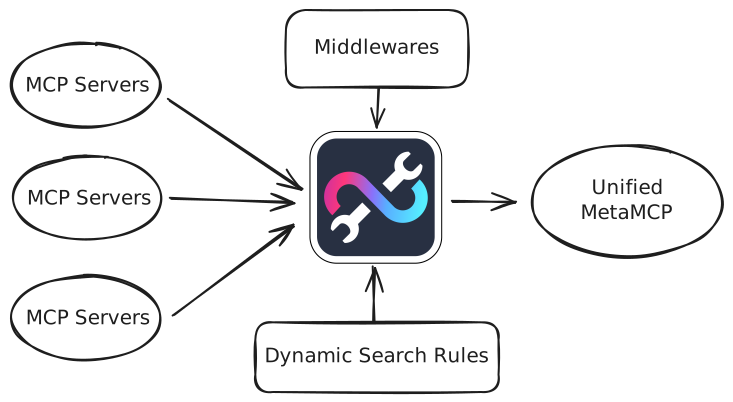
MetaMCP is a MCP proxy that lets you dynamically aggregate MCP servers into a unified MCP server, and apply middlewares. MetaMCP itself is a MCP server so it can be easily plugged into ANY MCP clients.
For more details, consider visiting our documentation site: https://docs.metamcp.com
English | 简体中文
📋 Table of Contents <!-- omit in toc -->
- 🎯 Use Cases
- 📖 Concepts
- 🚀 Quick Start
- 🔌 MCP Protocol Compatibility
- 🔗 Connect to MetaMCP
- ❄️ Cold Start Problem and Custom Dockerfile
- 🧾 Log Levels
- 🔐 Authentication
- 🚦 Traffic Management
- 🔗 OpenID Connect (OIDC) Provider Support
- ⚙️ Registration Controls
- 🌐 Custom Deployment and SSE conf for Nginx
- 🏗️ Architecture
- 🗺️ Roadmap
- 🌐 i18n
- 🤝 Contributing
- 📄 License
- 🙏 Credits
🎯 Use Cases
- 🏷️ Group MCP servers into namespaces, host them as meta-MCPs, and assign public endpoints (SSE or Streamable HTTP), with auth. One-click to switch a namespace for an endpoint.
- 🎯 Pick tools you only need when remixing MCP servers. Apply other pluggable middleware around observability, security, etc. (coming soon)
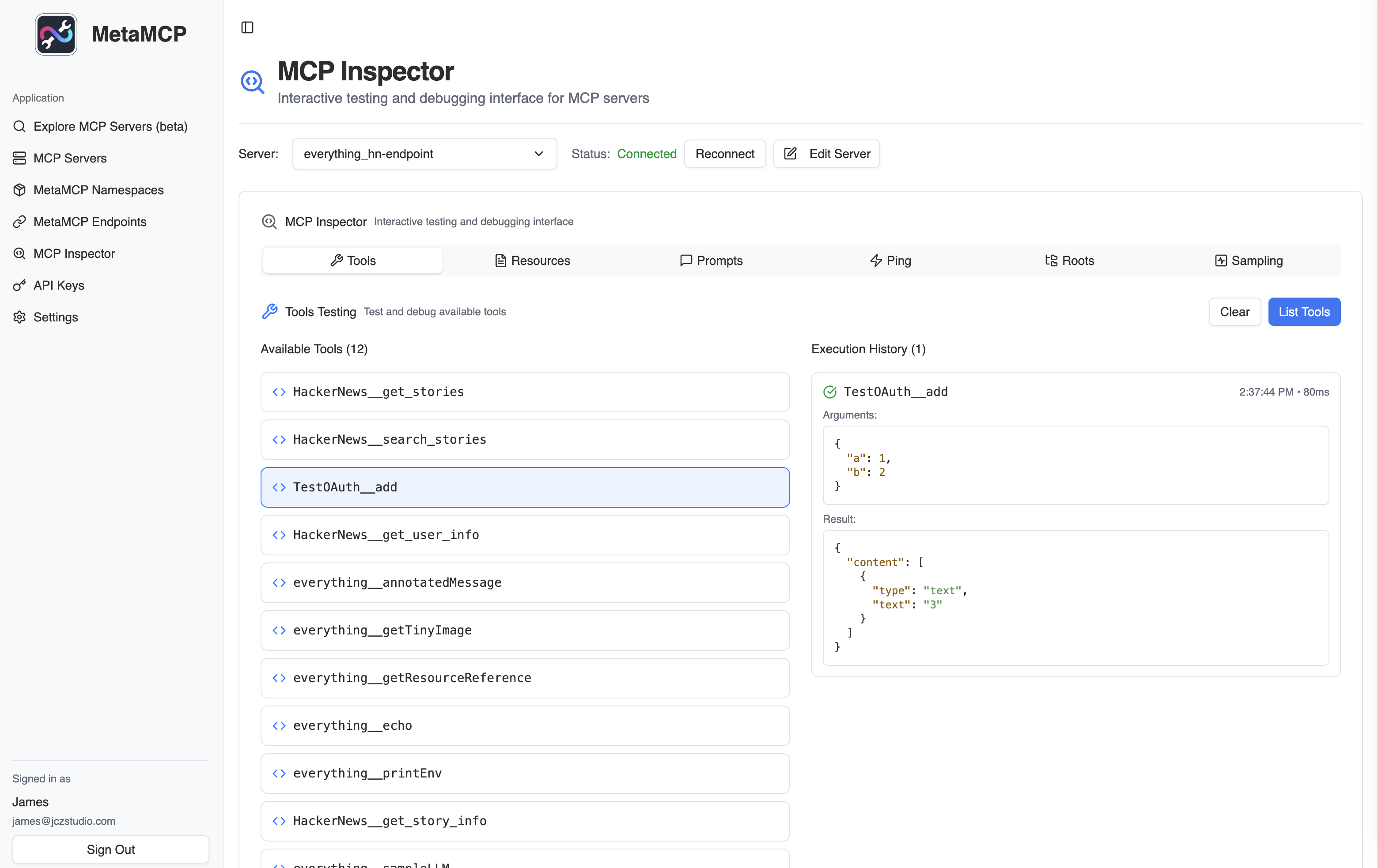
- 🔍 Use as enhanced MCP inspector with saved server configs, and inspect your MetaMCP endpoints in house to see if it works or not.
- 🔍 Use as Elasticsearch for MCP tool selection (coming soon)
Generally developers can use MetaMCP as infrastructure to host dynamically composed MCP servers through a unified endpoint, and build agents on top of it.
Quick demo video: https://youtu.be/Cf6jVd2saAs
📖 Concepts
🖥️ MCP Server
A MCP server configuration that tells MetaMCP how to start a MCP server.
"HackerNews": {
  "type": "STDIO",
  "command": "uvx",
  "args": ["mcp-hn"]
}🔐 Environment Variables & Secrets (STDIO MCP Servers)
For STDIO MCP servers, MetaMCP supports three ways to handle environment variables and secrets:
1. Raw Values - Direct string values (not recommended for secrets):
API_KEY=your-actual-api-key-here
DEBUG=true2. Environment Variable References - Use ${ENV_VAR_NAME} syntax:
API_KEY=${OPENAI_API_KEY}
DATABASE_URL=${DB_CONNECTION_STRING}3. Auto-matching - If the expected environment variable name in your tool matches the container's environment variable, you can omit it entirely. MetaMCP will automatically pass through matching environment variables.
🔒 Security Note: Environment variable references (
${VAR_NAME}) are resolved from the MetaMCP container's environment at runtime. This keeps actual secret values out of your configuration and git repository.
⚙️ Development Note: For local development with
pnpm run dev:docker, ensure your environment variables are listed inturbo.jsonunderglobalEnvto be passed to the development processes. This is not required for production Docker deployments.
🏷️ MetaMCP Namespace
- Group one or more MCP servers into a namespace
- Enable/disable MCP servers or at tool level
- Apply middlewares to MCP requests and responses
- Override tool names/titles/descriptions per namespace and attach custom MCP annotations (e.g.
{ "annotations": { "readOnlyHint": false } })
🌐 MetaMCP Endpoint
- Create endpoints and assign namespace to endpoints
- Multiple MCP servers in the namespace will be aggregated and emitted as a MetaMCP endpoint
- Choose between API-Key Auth (in header or query param) or standard OAuth in MCP Spec 2025-06-18
- Host through SSE or Streamable HTTP transports in MCP and OpenAPI endpoints for clients like Open WebUI
⚙️ Middleware
- Intercepts and transforms MCP requests and responses at namespace level
- Built-in example: "Filter inactive tools" - optimizes tool context for LLMs
- Future ideas: tool logging, error traces, validation, scanning
🔍 Inspector
Similar to the official MCP inspector, but with saved server configs - MetaMCP automatically creates configurations so you can debug MetaMCP endpoints immediately.
✏️ Tool Overrides & Annotations
- Open a namespace → Tools tab to see every tool coming from connected MCP servers.
- Each saved tool can be expanded and edited inline: update the display name/title/description or provide a JSON blob with namespace-specific annotations (for example
{ "annotations": { "readOnlyHint": false } }). - Badges in the table ("Overridden", "Annotations") show which tools currently have custom metadata. Hover them to read a tooltip describing what was overridden.
- Annotation overrides are merged with whatever the upstream MCP server returns, so you can safely add custom UI hints without losing provider metadata.
🚀 Quick Start
🐳 Run with Docker Compose (Recommended)
Clone repo, prepare .env, and start with docker compose:
git clone https://github.com/metatool-ai/metamcp.git
cd metamcp
cp example.env .env
docker compose up -dIf you modify APP_URL env vars, make sure you only access from the APP_URL, because MetaMCP enforces CORS policy on the URL, so no other URL is accessible.
Note that the pg volume name may collide with your other pg dockers, which is global, consider rename it in docker-compose.yml:
volumes:
  metamcp_postgres_data:
driver: local📦 Build development environment with Dev Containers (VSCode/Cursor)
You can use the VSCode/Cursor extension to build the development environment in a container.
It only requires that you have an environment running Docker or a similar alternative (the docker/docker compose command is required), and no other dependent components need to be installed on your host machine.
- First, clone the MetaMCP source code, open project in Visual Studio Code.
git clone https://github.com/metatool-ai/metamcp.git
cd metamcp
code .- Switch to Dev Containers. Open the VSCode Command Palette, and execute
Dev Containers: Reopen in Container.
VSCode will open the Dev Containers project in a new window, where it will build the runtime and install the toolchain according to the Dockerfile before starting the connection and finally installing the MetaMCP dependencies.
<img width="895" height="153" alt="image" src="https://github.com/user-attachments/assets/d3e1420d-43c1-4ed6-9229-b91ea09c142a" />
note This process requires a reliable network connection, and it will access Docker Hub, GitHub, and some other sites. You will need to ensure the network connection yourself, otherwise the container build may fail.
Wait some minutes, depending on the internet connection or computer performance, it may take from a few minutes to tens of minutes, you can click on the Progress Bar in the bottom right corner to view a live log where you will be able to check unusual stuck. <img width="732" height="173" alt="image" src="https://github.com/user-attachments/assets/6e5752f8-7353-4a8f-b489-c13daef6700
…