spreadsheet-kit




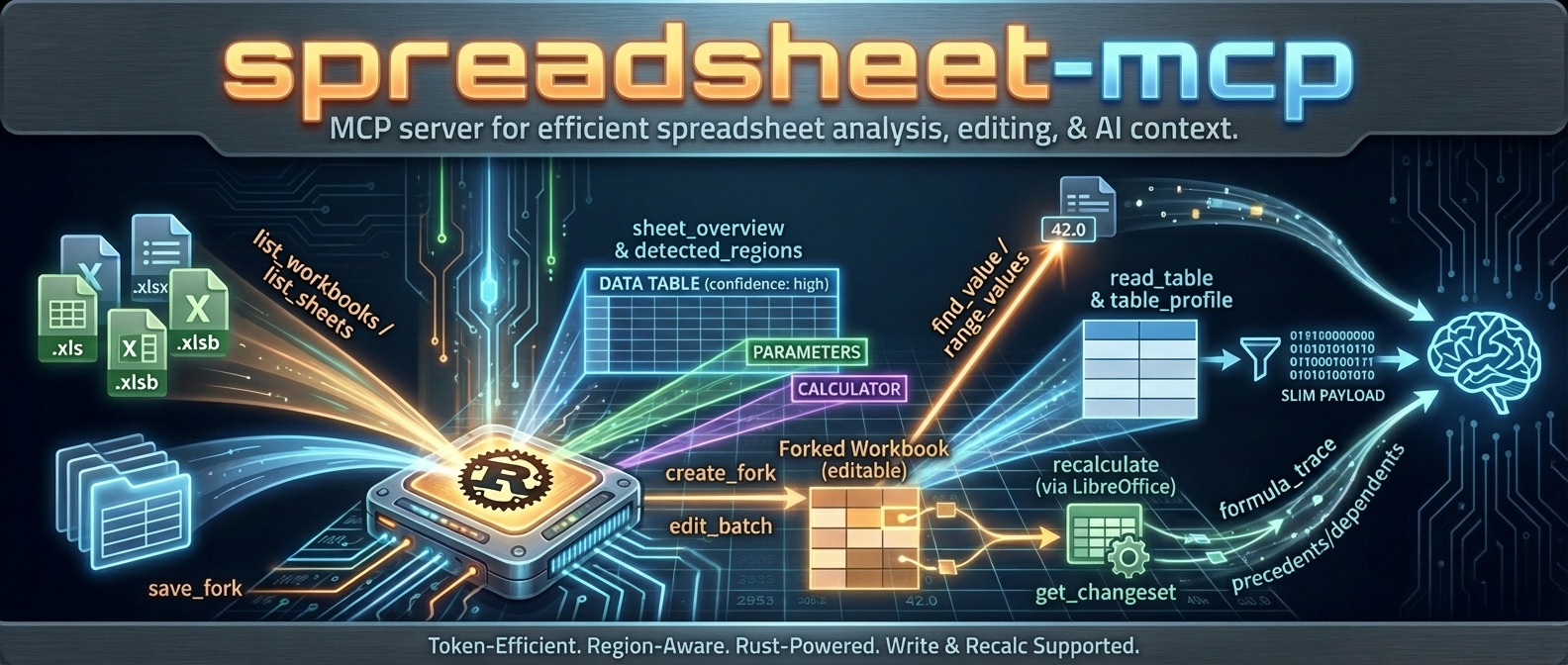
spreadsheet-kit is the tool interaction service for agent-based spreadsheet usage.
It gives agents a safe, inspectable, token-efficient way to read, analyze, mutate, verify, and operationalize Excel workbooks without falling back to brittle UI automation.
If you want an agent to work with spreadsheets like a real system instead of a screenshot puppet, this is the stack.
What this project is
spreadsheet-kit ships a unified spreadsheet interaction layer across four surfaces:
| Surface | Binary / Package | Mode | Best for |
|---|---|---|---|
| CLI | asp / agent-spreadsheet | Stateless | One-shot reads, safe edits, pipelines, CI, agent tool calls |
| MCP server | spreadsheet-mcp | Stateful | Multi-turn agent sessions, workbook caching, fork/recalc workflows |
| JS SDK | spreadsheet-kit-sdk | Backend-agnostic | App integrations that can target MCP today and WASM/session backends over time |
| WASM runtime | spreadsheet-kit-wasm | In-process | Experimental byte/session embedding for local runtimes |
Supported workbook modes:
.xlsx/.xlsm— read + write.xls/.xlsb— discovery/read-oriented workflows only
Why agents use spreadsheet-kit
Built for tool use, not just humans
- deterministic JSON contracts
- schema and example discovery from the CLI itself
- explicit pagination and compact output modes
- machine-readable warnings and error envelopes
Safe mutation, not blind mutation
- dry-run first workflows
- stateless output modes and overwrite safety
- event-sourced session editing
- verification surfaces for proving downstream outcomes
- structural impact analysis before risky workbook changes
Spreadsheet-aware, not generic file editing
- region detection
- table and footer-aware append helpers
- template row / row band cloning
- formula-specific replace and diagnostics
- named range CRUD
- recalculation + diff + proof flows
Good agent ergonomics
- nested command groups with legacy alias compatibility
- token-efficient reads
- exact-cell inspection and layout inspection
- workflow helpers for the repetitive parts agents usually get wrong
What is new / what makes this stack different
The current surface is much stronger than a plain “read some cells” tool. Major capabilities now include:
aspas the primary CLI withagent-spreadsheetpreserved as a compatibility alias- grouped verification via
asp verify proofandasp verify diff - preview-first workflow helpers for:
write appendwrite clone-template-rowwrite clone-row-band
- formula-safe batch workflows with parse-policy diagnostics
- cell/layout/export/import inspection surfaces
- named range management (
write name define|update|delete) - formula-only replacement (
write formulas replace) - event-sourced session editing with log, branch, undo/redo, fork, apply, and materialize
- SheetPort manifest lifecycle + execution for contract-driven spreadsheet automation
Install
npm (recommended for CLI)
npm i -g agent-spreadsheet
asp --helpInstalls both:
asp— primary commandagent-spreadsheet— compatibility alias
Downloads a prebuilt native binary for your platform. No Rust toolchain required.
Cargo
# CLI
cargo install spreadsheet-kit --features recalc --bin asp --bin agent-spreadsheet

# MCP server
cargo install spreadsheet-mcpFormualizer (the native Rust recalc engine) is included by default.
Docker
# Read-only / slim
docker pull ghcr.io/psu3d0/spreadsheet-mcp:latest

# Write + recalc + screenshots
docker pull ghcr.io/psu3d0/spreadsheet-mcp:latest-fullJavaScript SDK
npm i spreadsheet-kit-sdkPrebuilt binaries
Download from GitHub Releases.
Published native assets include:
- Linux x86_64
- macOS x86_64
- macOS arm64
- Windows x86_64
Start here: the core workflows
1) Orient the workbook before reading cells
# What sheets are here?
asp read sheets data.xlsx

# What regions/tables/parameter blocks does this sheet contain?
asp read overview data.xlsx "Model"

# What named items are available?
asp read names data.xlsx

# Read a structured region as a table
asp read table data.xlsx --sheet "Model"2) Inspect exactly what an agent needs
# Raw values for exact ranges
asp read values data.xlsx Model A1:C20

# Detail-view for targeted cells (value / formula / cached / style triage)
asp read cells data.xlsx Model B2 D10:F12

# Layout-aware rendering for a bounded range
asp read layout data.xlsx Model --range A1:H30 --render both

# Export a bounded range to csv or grid json
asp read export data.xlsx Model A1:H30 --format csv --output model.csv3) Do a safe stateless edit → recalc → proof → diff loop
asp workbook copy data.xlsx /tmp/draft.xlsx
asp write cells /tmp/draft.xlsx Inputs "B2=500" "C2==B2*1.1"
asp workbook recalculate /tmp/draft.xlsx
asp verify proof data.xlsx /tmp/draft.xlsx --targets Summary!B2,Summary!B3 --named-ranges
asp verify diff data.xlsx /tmp/draft.xlsx --details --limit 50A representative label-mode lookup:
asp analyze find-value data.xlsx "Net Income" --mode label --label-direction below4) Preview structural risk before mutating the workbook
asp analyze ref-impact data.xlsx --ops @structure_ops.json --show-formula-deltaThis is intentionally read-only. It surfaces shifted spans, absolute-reference warnings, token counts, and optional before/after formula samples.
5) Use workflow helpers instead of reinventing row logic
# Stateless batch writes
asp write batch transform data.xlsx --ops @ops.json --dry-run
asp write batch style data.xlsx --ops @style_ops.json --dry-run

# Append rows into a detected region or table, respecting footer rows when present
asp write append data.xlsx --sheet Revenue --table-name RevenueTable --from-csv rows.csv --header --dry-run

# Clone one template row with preview-first planning
asp write clone-template-row data.xlsx --sheet Inputs --source-row 8 --after 8 --count 3 --dry-run

# Clone a contiguous row band repeatedly
asp write clone-row-band data.xlsx --sheet Forecast --source-rows 12:16 --after 16 --repeat 4 --dry-run6) Use a stateful session when the edit story gets complex
asp session start --base data.xlsx --workspace .
asp session op --session <id> --ops @edit.json --workspace .
asp session apply --session <id> <staged_id> --workspace .
asp session materialize --session <id> --output result.xlsx --workspace .And when you need proper history and branching:
asp session log --session <id> --workspace .
asp session fork --session <id> scenario-a --workspace .
asp session undo --session <id> --workspace .
asp session redo --session <id> --workspace .
asp session checkout --session <id> <op_id> --workspace .7) Turn workbook interfaces into contracts with SheetPort
# Discover candidate ports from workbook structure
asp sheetport manifest candidates model.xlsx

# Validate or normalize a manifest
asp sheetport manifest validate manifest.yaml
asp sheetport manifest normalize manifest.yaml

# Bind-check a workbook against a manifest
asp sheetport bind-check model.xlsx manifest.yaml

# Execute the manifest with JSON inputs
asp sheetport run model.xlsx manifest.yaml --inputs @inputs.jsonCLI overview
The primary CLI is asp.
agent-spreadsheet remains available as a compatibility alias, so both of these are valid:
asp read sheets data.xlsx
agent-spreadsheet read sheets data.xlsxPreferred command groups
asp read ...asp analyze ...asp write ...asp workbook ...asp verify ...asp session ...asp sheetport ...
Legacy aliases
Legacy flat commands are still normalized to the new nested surface where practical. That makes migration easier for older prompts, docs, and automation.
Discoverability built into the CLI
When an agent is unsure of payload shape, it can ask the tool directly:
asp schema write batch transform
asp example write batch transform
asp schema session op transform.write_matrix
asp example session op transform.write_matrixThis is a core design principle: the surface should explain itself to the agent.
Command families
read — extraction and inspection
| Command | Purpose |
|---|---|
asp read sheets <file> | List sheets with summary metadata |
asp read overview <file> <sheet> | Detect regions, headers, and orientation |
asp read values <file> <sheet> <range> [range...] | Pull raw values for exact A1 ranges |
asp read export <file> <sheet> <range> | Export a bounded range to csv or grid json |
asp read cells <file> <sheet> <target> [target...] | Inspect exact cells/ranges with value/formula/cached/style snapshots |
asp read page <file> <sheet> ... | Deterministic sheet paging with next_start_row |
asp read table <file> ... | Structured table/region read with deterministic next_offset |
asp read names <file> | Named ranges, named formulas, and table items |
asp read workbook <file> | Workbook-level metadata |
asp read layout <file> <sheet> | Layout-aware rendering with widths, merges, borders, and optional ascii output |
Why these matter for agents
Agents rarely need “the whole spreadsheet.” They need:
- the right region
- the right page
- the right cells
- just enough layout to understand intent
That is why the read surface combines region detection, structured reads, detail inspection, and explicit continuation.
analyze — search, diagnostics, and impact understanding
| Command | Purpose |
|---|---|
asp analyze find-value <file> <query> | Search by value or by label semantics |
asp analyze find-formula <file> <query> | Text search within formulas |
asp analyze formula-map <file> <sheet> | Summarize formulas by complexity/frequency |
asp analyze formula-trace <file> <sheet> <cell> <precedents|dependents> | Dependency tracing with continuation |
asp analyze scan-volatiles <file> | Find volatile formulas |
asp analyze sheet-statistics <file> <sheet> | Density and type statistics |
asp analyze table-profile <file> | Header/type/cardinality profiling |
asp analyze ref-impact <file> --ops @structure_ops.json | Preflight structural edit impact without mutation |
Why this matters
Headless spreadsheet automation wins when it can explain consequences, not just execute mutations. ref-impact, formula-trace, and grouped diagnostics are all part of that story.
write — safe mutations and workflow helpers
| Command | Purpose |
|---|---|
asp write cells <file> <sheet> ... | Direct shorthand cell edits |
asp write import <file> <sheet> ... | Import grid json or csv into a workbook range |
asp write append ... | Footer-aware row append into a region or table |
asp write clone-template-row ... | Clone one template row with preview-first planning |
asp write clone-row-band ... | Clone a multi-row template band repeatedly |
asp write formulas replace ... | Formula-only find/replace on a sheet/range |
| `asp write name define | update |
…