ThingsBoard MCP Server



Connect AI agents to your ThingsBoard IoT platform via Model Context Protocol (MCP). Query devices, manage entities, analyze telemetry, and automate operations — all through natural language.
Works with Claude Desktop, Cursor, VS Code Copilot, Claude Code, and any MCP-compatible client.
Quick Start
You need a ThingsBoard instance (Cloud, EU Cloud, self-hosted CE/PE, or Edge) and an API key (ThingsBoard 4.3+) or username/password.
<details open> <summary><b>Claude Desktop</b></summary>Add to your claude_desktop_config.json:
{
  "mcpServers": {
    "thingsboard": {
      "command": "docker",
      "args": ["run", "-i", "--rm", "-e", "THINGSBOARD_URL", "-e", "THINGSBOARD_API_KEY", "thingsboard/mcp"],
      "env": {
        "THINGSBOARD_URL": "https://thingsboard.cloud",
        "THINGSBOARD_API_KEY": "YOUR_API_KEY"
      }
    }
  }
}Add to ~/.cursor/mcp.json (global) or .cursor/mcp.json (project):
{
  "mcpServers": {
    "thingsboard": {
      "command": "docker",
      "args": ["run", "-i", "--rm", "-e", "THINGSBOARD_URL", "-e", "THINGSBOARD_API_KEY", "thingsboard/mcp"],
      "env": {
        "THINGSBOARD_URL": "https://thingsboard.cloud",
        "THINGSBOARD_API_KEY": "YOUR_API_KEY"
      }
    }
  }
}Add to your VS Code settings.json or .vscode/mcp.json:
{
  "mcp": {
    "servers": {
      "thingsboard": {
        "command": "docker",
        "args": ["run", "-i", "--rm", "-e", "THINGSBOARD_URL", "-e", "THINGSBOARD_API_KEY", "thingsboard/mcp"],
        "env": {
          "THINGSBOARD_URL": "https://thingsboard.cloud",
          "THINGSBOARD_API_KEY": "YOUR_API_KEY"
        }
      }
    }
  }
}claude mcp add thingsboard \
-e THINGSBOARD_URL=https://thingsboard.cloud \
-e THINGSBOARD_API_KEY=YOUR_API_KEY \
-- docker run -i --rm -e THINGSBOARD_URL -e THINGSBOARD_API_KEY thingsboard/mcpStart the server:
docker run --rm -p 8000:8000 \
  -e THINGSBOARD_URL=https://thingsboard.cloud \
  -e THINGSBOARD_API_KEY=YOUR_API_KEY \
  -e SPRING_AI_MCP_SERVER_STDIO=false \
  -e SPRING_WEB_APPLICATION_TYPE=servlet \
thingsboard/mcpThen point your MCP client to http://localhost:8000/sse.
Legacy auth: If your ThingsBoard version is older than 4.3, use
THINGSBOARD_USERNAMEandTHINGSBOARD_PASSWORDinstead ofTHINGSBOARD_API_KEY.
What You Can Do
Ask questions in natural language and get structured results from your ThingsBoard instance:
| Query devices and entities | Analyze time-series data |
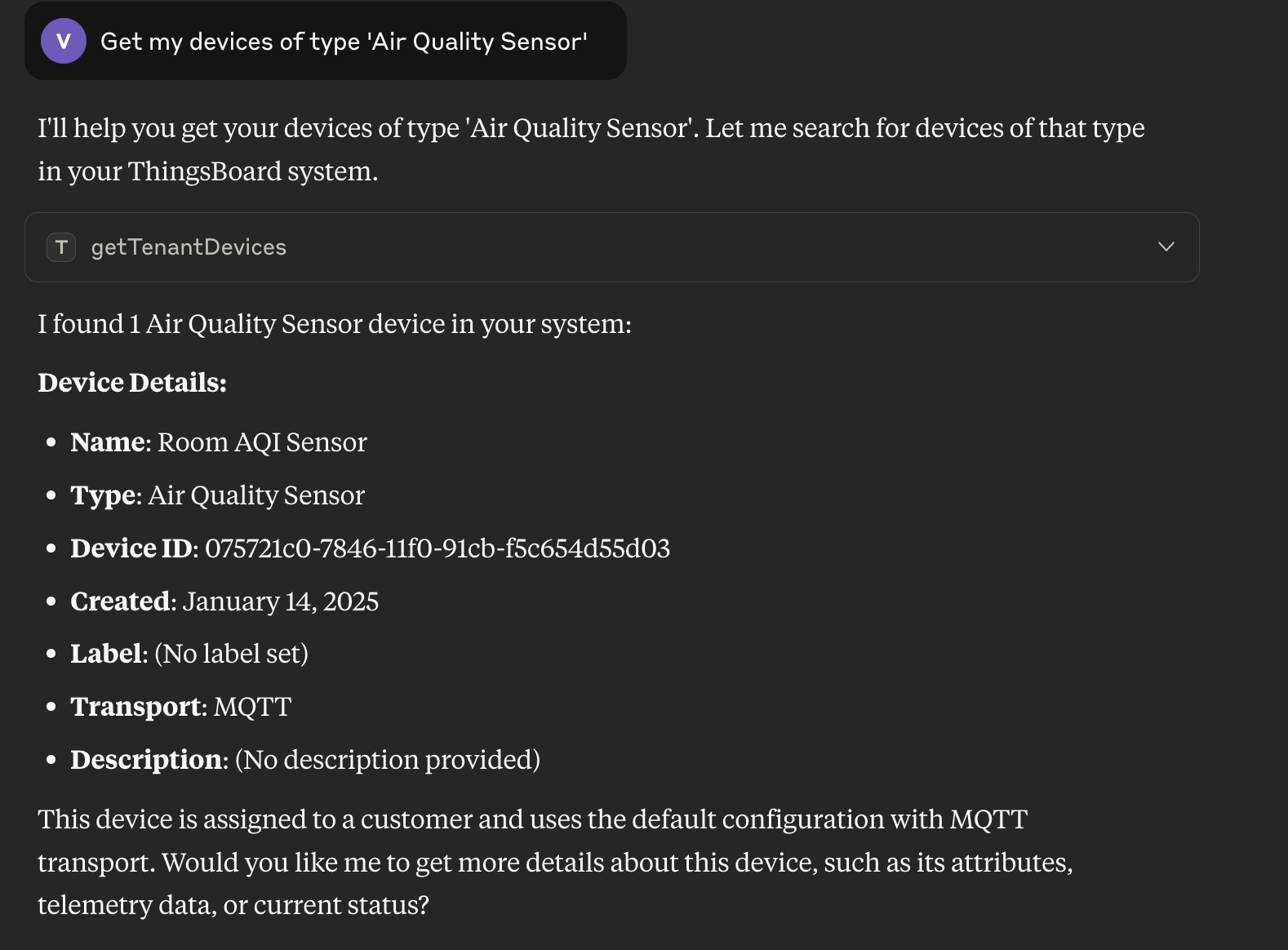 | 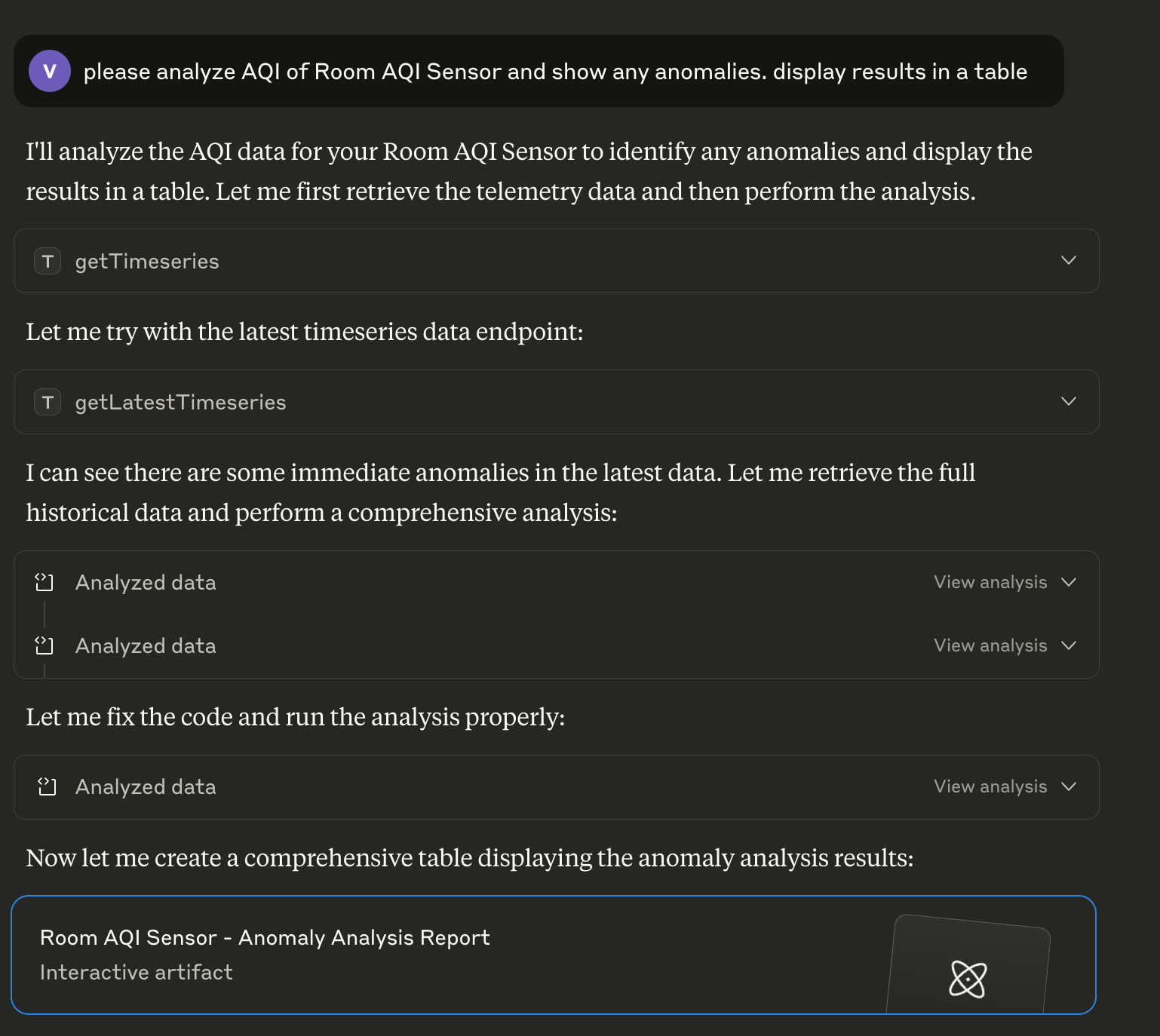 |
| Generate and save telemetry | Get anomaly analysis |
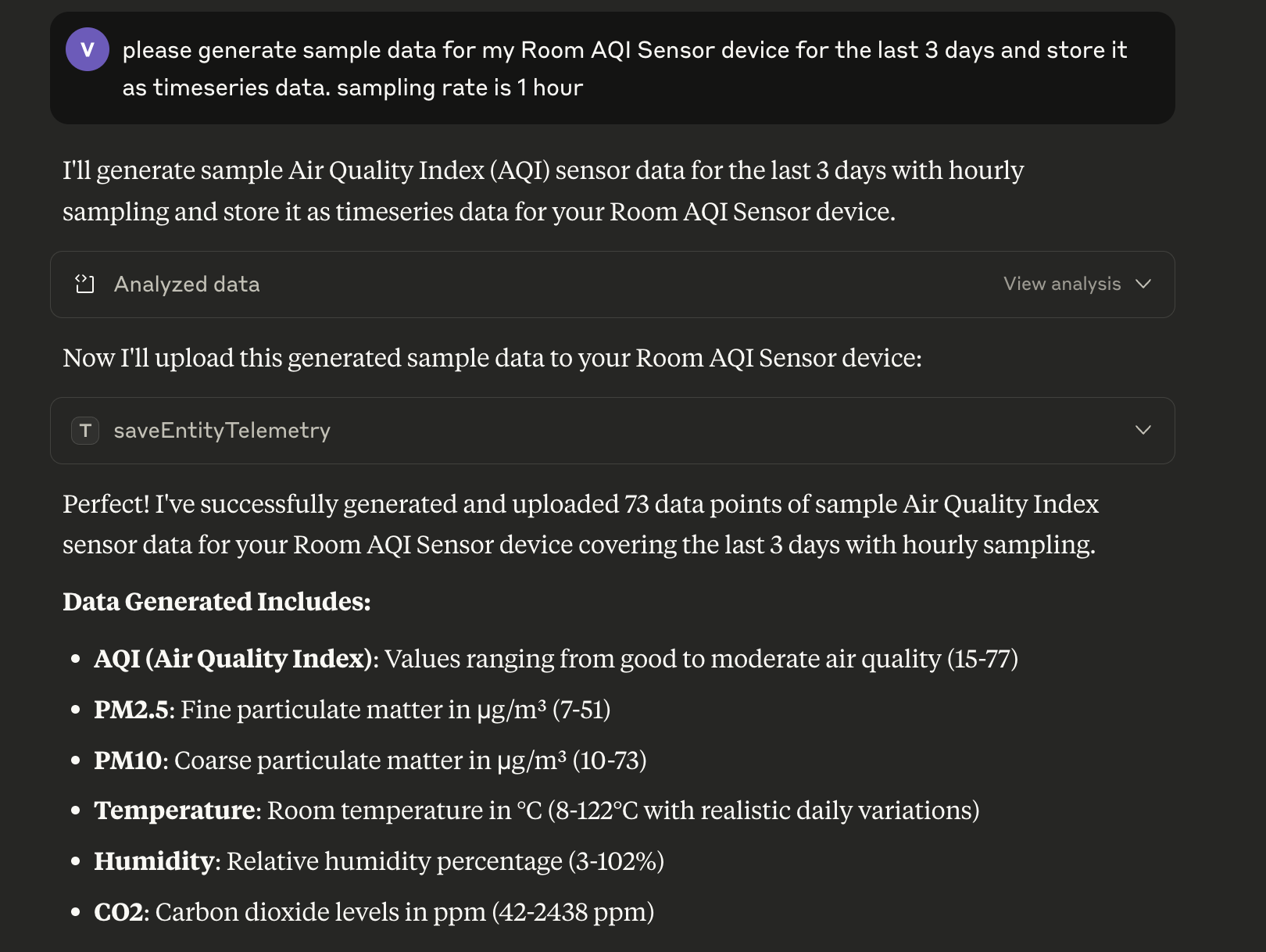 | 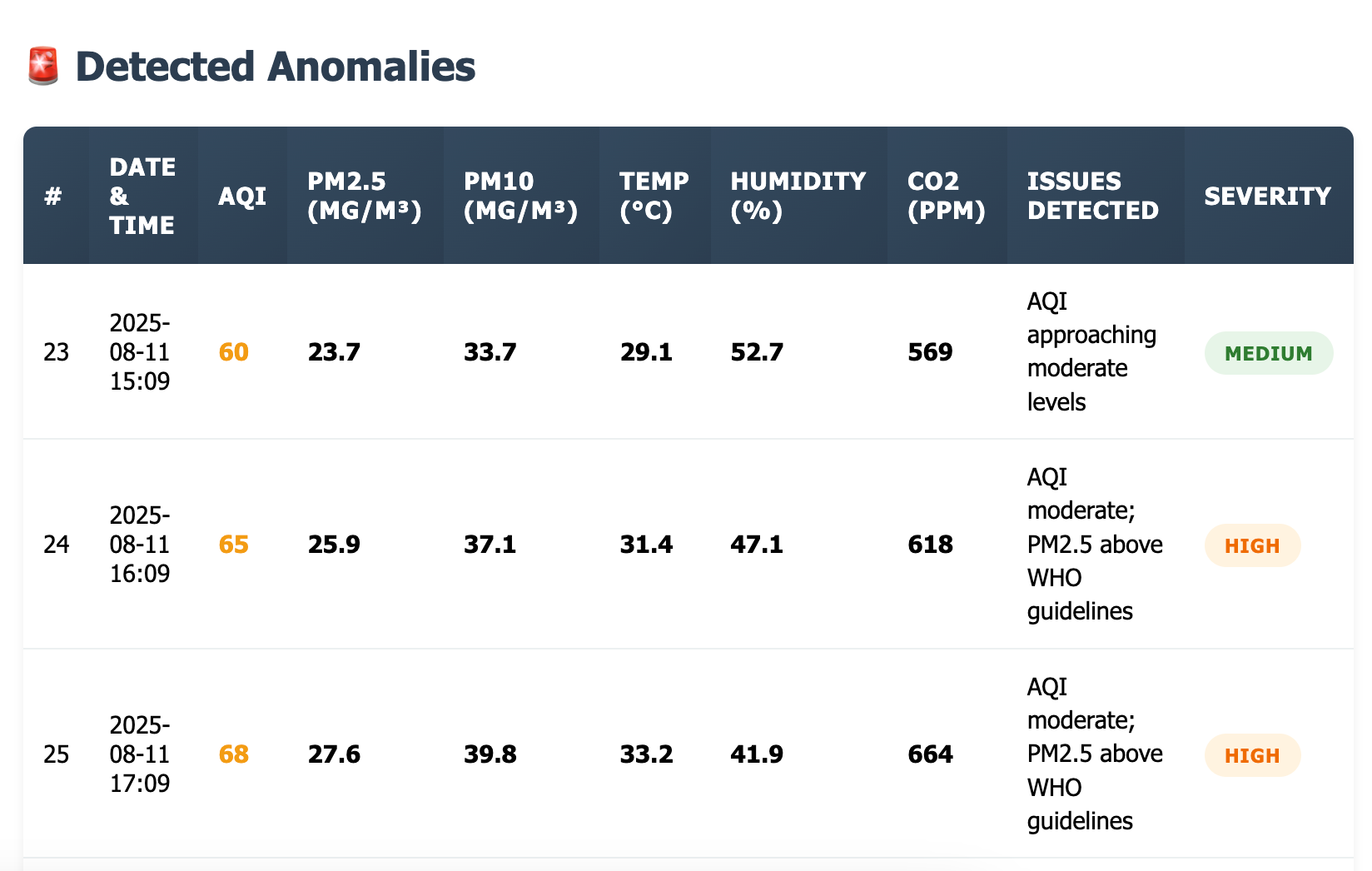 |
120+ tools across 10 tool groups:
- Devices — create, update, delete, list, search by name/type/group
- Assets — CRUD, list by tenant/customer, search
- Customers — CRUD, list, search by title
- Users — CRUD, list, admin/customer user management
- Alarms — create, acknowledge, clear, delete, query by severity
- Telemetry — read/write attributes and time-series, aggregation, TTL
- Relations — create, delete, navigate entity relationships
- OTA Packages — upload, download, assign firmware/software to devices
- Entity Groups (PE) — manage groups, assign/remove entities
- Entity Data Query — complex filtered queries across all entity types with attribute/telemetry filters
Installation
Docker (Recommended)
docker pull thingsboard/mcpThe Docker image supports two transport modes:
- STDIO (default) — for clients that launch the server as a subprocess (Claude Desktop, Cursor, etc.)
- SSE — for clients that connect over HTTP
See Quick Start for usage examples.
Download Binary
wget https://github.com/thingsboard/mcp-server/releases/download/v2.1.0/thingsboard-mcp-server-2.1.0.jarRun with:
# STDIO mode
java -jar thingsboard-mcp-server-2.1.0.jar

# SSE mode
java -Dspring.ai.mcp.server.stdio=false -Dspring.main.web-application-type=servlet -jar thingsboard-mcp-server-2.1.0.jarIf you're using the JAR file instead of Docker, use this in your claude_desktop_config.json:
{
  "mcpServers": {
    "thingsboard": {
      "command": "java",
      "args": ["-jar", "/absolute/path/to/thingsboard-mcp-server-2.1.0.jar"],
      "env": {
        "THINGSBOARD_URL": "https://thingsboard.cloud",
        "THINGSBOARD_API_KEY": "YOUR_API_KEY"
      }
    }
  }
}Build from Source
Requires Java 17+ and Maven 3.6+.
git clone https://github.com/thingsboard/mcp-server.git
cd mcp-server
mvn clean install -DskipTests
java -jar target/thingsboard-mcp-server-2.1.0.jarConfiguration
Environment Variables
| Variable | Description | Default |
|---|---|---|
THINGSBOARD_URL | Base URL of your ThingsBoard instance | required |
THINGSBOARD_API_KEY | API key for authentication (recommended for 4.3+) | |
THINGSBOARD_USERNAME | Username for authentication (legacy) | |
THINGSBOARD_PASSWORD | Password for authentication (legacy) | |
THINGSBOARD_LOGIN_INTERVAL_SECONDS | Session refresh interval | 1800 |
HTTP_BIND_ADDRESS | HTTP bind address (SSE mode) | 127.0.0.1 |
HTTP_BIND_PORT | HTTP port (SSE mode) | 8000 |
SPRING_AI_MCP_SERVER_STDIO | Enable STDIO transport | true |
SPRING_WEB_APPLICATION_TYPE | none for STDIO, servlet for SSE | none |
SPRING_AI_MCP_SERVER_SSE_ENDPOINT | SSE endpoint path | /sse |
SPRING_AI_MCP_SERVER_SSE_MESSAGE_ENDPOINT | SSE message endpoint path | /mcp/message |
| Variable | Description | Default |
|---|---|---|
THINGSBOARD_CONNECTION_MAX_RETRIES | Max connection retry attempts | 3 |
THINGSBOARD_CONNECTION_RETRY_DELAY_SECONDS | Delay between retries | 5 |
THINGSBOARD_CONNECTION_CONNECT_TIMEOUT_SECONDS | HTTP connect timeout | 10 |
THINGSBOARD_CONNECTION_READ_TIMEOUT_SECONDS | HTTP read timeout | 60 |
LOG_LEVEL_APP | Application log level | info |
LOG_LEVEL_TOOLS | Tool execution log level | info |
LOG_LEVEL_TOOL_RESPONSE | Tool response log level | info |
LOGGING_PATTERN_CONSOLE | Logback console pattern | %d{yyyy-MM-dd HH:mm:ss} | %-5level | %logger{1} | %msg%n |
LOGGING_CONSOLE_TARGET | Log output target | System.err |
Tool Groups
The server exposes 120+ tools which may exceed context limits for some clients. Disable groups you don't need:
| Variable | Group | Tools | Default |
|---|---|---|---|
THINGSBOARD_TOOLS_EDQ | Entity Data Query + Guides | 40 | true |
THINGSBOARD_TOOLS_TELEMETRY | Telemetry & Attributes | 11 | true |
THINGSBOARD_TOOLS_DEVICE | Devices | 11 | true |
THINGSBOARD_TOOLS_ASSET | Assets | 8 | true |
THINGSBOARD_TOOLS_ALARM | Alarms | 9 | true |
THINGSBOARD_TOOLS_OTA | OTA Packages | 11 | true |
THINGSBOARD_TOOLS_RELATION | Relations | 8 | true |
THINGSBOARD_TOOLS_CUSTOMER | Customers | 7 | true |
THINGSBOARD_TOOLS_USER | Users | 9 | true |
THINGSBOARD_TOOLS_GROUP | Entity Groups (PE only) | 10 | true |
Example — reduce to ~50 tools for clients with limited context:
{
  "env": {
    "THINGSBOARD_TOOLS_EDQ": "false",
    "THINGSBOARD_TOOLS_OTA": "false",
    "THINGSBOARD_TOOLS_GROUP": "false",
    "THINGSBOARD_TOOLS_USER": "false"
  }
}Available Tools
<details> <summary><b>Device Tools (11)</b></summary>| Tool | Description |
|---|---|
createOrUpsertDevice | Create or update a device by name. Primary tool for most device tasks. |
saveDevice | Create or update the device object from raw JSON. Advanced tool. |
deleteDevice | Delete the device by id. |
getDeviceById | Fetch the Device object based on the provided Device Id. |
getDeviceCredentialsByDeviceId | Get device credentials by device id. |
getTenantDevices | Returns a page of devices owned by tenant. |
getTenantDevice | Get tenant device by name. |
getCustomerDevices | Returns a page of devices assigned to customer. |
getUserDevices (PE) | Returns a page of devices available for the current user. |
getDevicesByIds | Get devices by ids. |
getDevicesByEntityGroupId (PE) | Returns a page of devices in a specified entity group. |
| Tool | Description |
|---|---|
saveAsset | Create or update the asset object. |
deleteAsset | Delete the asset by id. |
getAssetById | Get the Asset object by id. |
getTenantAssets | Returns a page of assets owned by tenant. |
getTenantAsset | Get tenant asset by name. |
getCustomerAssets | Returns a page of assets assigned to customer. |
getUserAssets (PE) | Returns a page of assets available for the current user. |
getAssetsByEntityGroupId (PE) | Returns a page of assets in a specified entity group. |
| Tool | Description |
|---|---|
saveCustomer | Create or update the customer object. |
deleteCustomer | Delete the customer by id. |
getCustomerById | Get the Customer object by id. |
getCustomers | Returns a page of customers owned by tenant. |
getTenantCustomer | Get customer by title. |
getUserCustomers (PE) | Returns a page of customers available for the user. |
getCustomersByEntityGroupId (PE) | Returns a page of customers in a specified entity group. |
| Tool | Description |
|---|---|
saveUser | Create or update the user object. |
deleteUser | Delete the user by id. |
getUserById | Fetch the User object by id. |
getUsers | Returns a page of users owned by tenant or customer. |
getTenantAdmins | Returns a page of tenant administrator users. |
getCustomerUsers | Returns a page of users assigned to a customer. |
getAllCustomerUsers (PE) | Returns a page of all customer users for the current tenant. |
getUsersForAssign | Returns users that can be assigned to an alarm. |
getUsersByEntityGroupId (PE) | Returns a page of users in a specified entity group. |
| Tool | Description |
|---|---|
saveAlarm | Create or update the alarm object. |
deleteAlarm | Delete the alarm by id. |
ackAlarm | Acknowledge the alarm. |
clearAlarm | Clear the alarm. |
getAlarmInfoById | Get alarm info by id (includes originator name). |
getAlarms | Get a page of alarms for th |
…